.webp)
FOOD PROCESSING ETP CASE STUDY
How a Food Processing Plant Achieved 95% ETP Odour Control
Industry: Food & Beverage / Food Additives Manufacturing (Bakery, Distillery, Food & Pharma)
Process: Molasses Fermentation & High-Temp (70 - 80°C) Anaerobic Digestion
Total Emission Footprint: 1,770 m² across MEE Tanks, Equalization & Vacuum Vents
75–95%
Overall Site Odour Reduction
94.9%
Acetic Acid Reduction
91%
Average TVOC Reduction

This food processing ETP odour control case study explains how a food additives manufacturing plant achieved up to 95% odour control across high-COD wastewater tanks using OdoServe Odour Control and a high-pressure FOG cannon. The solution eliminated 100% of Trimethylamine and TVOC at MEE feed tanks while reducing Acetic Acid by 94.9%, Ammonia by 93.2%, and Hydrogen Sulphide by 71.8%, significantly improving workplace air quality and odour management.
Background & Technical Challenge
Plant Overview
A leading food additives manufacturing plant producing ingredients for the bakery, distillery, food, and pharmaceutical industries generated high-strength process wastewater from molasses fermentation and high-temperature anaerobic digestion. During wastewater treatment, molasses-based feedstock processed at 70–80°C released a range of volatile organic compounds, sulphur compounds, amines, and organic acids that created persistent odour emissions across the effluent treatment plant (ETP).
The primary odour sources included three High-COD Multiple Effect Evaporator (MEE) feed tanks, an equalisation tank, and two vacuum pump vents, covering a combined emission area of 1,770 m². Gas analysis identified odorous compounds such as Acetic Acid, Propionic Acid, Ammonia, Hydrogen Sulphide (H₂S), Acetaldehyde, Methyl Mercaptan, Methyl Sulfide, Trimethylamine, Ethanol, Sulphur Dioxide, and Total Volatile Organic Compounds (TVOC). These emissions created an unpleasant working environment and increased the potential for occupational health concerns associated with prolonged exposure to fermentation-derived gases.
To control these emissions, the facility implemented OdoServe™ odour control through a wheel-mounted high-pressure FOG cannon. The system generated ultra-fine mist droplets that continuously covered the open tank surfaces and process vents, enabling effective odour neutralisation across the food processing ETP.
The Technical Challenge & Risk
High-COD MEE Feed Tank Emissions – Three open MEE feed tanks covering 1,500 m² released concentrated volatile organic acids, sulphur compounds, and amines during high-temperature wastewater handling.
Equalisation Tank Off-Gassing – The 250 m² equalisation tank emitted elevated concentrations of Acetic Acid, Ammonia, Hydrogen Sulphide, Ethanol, and other volatile organic compounds, creating continuous odour nuisance.
Vacuum Pump Vent Emissions – Two vacuum pump vents discharged concentrated process exhaust gases containing volatile organic compounds and odorous gases into the surrounding work environment.
Occupational Health & Safety Risks – Continuous exposure to ammonia, hydrogen sulphide, volatile organic acids, and amine compounds increased the risk of respiratory irritation, unpleasant working conditions, and employee discomfort.
Need for Large-Area Open Tank Odour Control – The facility required an odour control solution capable of effectively treating emissions across large open wastewater tanks and process vents without disrupting normal plant operations.
Food ETP Site Assessment
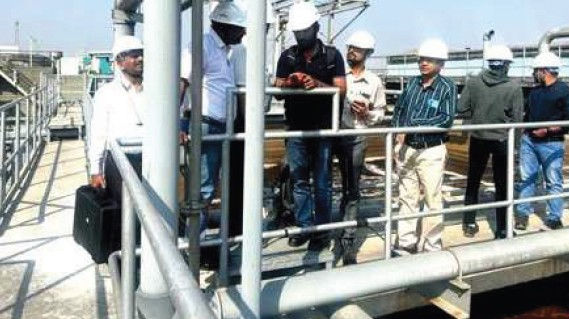
Engineers conducting an on-site assessment of the food processing ETP to identify major odour sources and evaluate emission hotspots before implementing the OdoServe™ odour control solution.
Before deploying the odour control system, Amalgam Biotech conducted a comprehensive site assessment to identify the primary sources of odour emissions across the food processing ETP. The evaluation focused on the High-COD MEE feed tanks, equalisation tank, and vacuum pump vents to determine the extent of odour generation and develop an effective misting strategy. The assessment also helped define the optimum equipment placement, mist coverage, and operating protocol required to achieve consistent odour control across the 1,770 m² emission area.
Assessment Highlights
Odour Source Identification: Identified the High-COD MEE feed tanks, equalisation tank, and vacuum pump vents as the primary sources of odour emissions within the food processing ETP.
Gas Analysis Assessment: Evaluated the presence of key odorous gases, including Acetic Acid, Propionic Acid, Ammonia (NH₃), Hydrogen Sulphide (H₂S), Acetaldehyde, Methyl Mercaptan, Methyl Sulfide, Trimethylamine, Ethanol, Sulphur Dioxide, and Total Volatile Organic Compounds (TVOC).
System Coverage Planning: Determined the optimum FOG cannon placement and mist coverage required to treat odour emissions across the 1,770 m² operational area.
Operational Assessment: Assessed process conditions around the MEE feed tanks, equalisation tank, and vacuum pump vents to establish an effective intermittent misting schedule without disrupting routine plant operations.
OdoServe Odour Control Strategy
Why OdoServe™ Odour Control Solution Was Selected
To control persistent odours generated from high-COD wastewater tanks, Amalgam Biotech implemented OdoServe™ odour control through a wheel-mounted high-pressure FOG cannon. The solution was selected for its ability to neutralise odorous compounds released during molasses fermentation and high-temperature anaerobic digestion, providing effective odour control across large open tank surfaces and process vents.
Unlike conventional odour control methods that rely on masking agents or fixed ducted systems, the OdoServe™ odour control solution utilised ultra-fine mist droplets to maximise contact with airborne odorous compounds. Combined with an intermittent operating schedule, the system delivered consistent odour suppression across the 1,770 m² emission area while maintaining normal plant operations and optimising chemical consumption.
Key Benefits
Neutralised odorous compounds generated from high-COD wastewater treatment processes.
Achieved 75–95% odour control across High-COD MEE feed tanks, equalisation tank, and vacuum pump vents.
Eliminated 100% of Trimethylamine and TVOC at High-COD MEE feed tanks.
Reduced emissions of Acetic Acid, Propionic Acid, Ammonia, Hydrogen Sulphide (H₂S), Acetaldehyde, Methyl Mercaptan, Methyl Sulfide, and other volatile compounds.
Improved workplace air quality across open wastewater treatment areas.
Delivered effective odour control over large open tank surfaces using a mobile high-pressure FOG cannon.
Optimised chemical usage through intermittent operation and a 1:1000 dilution ratio.
OdoServe Deployment Strategy
The odour control system was engineered to provide effective mist coverage across the food processing ETP using a wheel-mounted high-pressure FOG cannon operating with OdoServe™ odour control. The deployment strategy focused on maximising contact between ultra-fine mist droplets and airborne odorous compounds generated from the facility's major emission sources.
Source Control
Neutralised odours at key emission sources.
FOG Cannon Coverage
Covered all major emission areas.
Optimised Dosing
Maximised efficiency with intermittent dosing.
Continuous Protection
Maintained consistent odour reduction.
Target Malodorous Compounds (11-Gas Identification Matrix)
Gas Parameter | Chemical Formula | Health & Operational Risk |
Acetaldehyde | CH₃CHO | Sharp, pungent respiratory irritant |
Acetic Acid | CH₃COOH | Pungent vinegar odor, highly corrosive vapor |
Ammonia | NH₃ | Sharp alkaline odor, eye and throat irritant |
Ethanol | C₂H₅OH | Fermentation solvent vapor |
Hydrogen Sulfide | H₂S | Rotten egg toxic gas |
Methyl Mercaptan | CH₄S | Extremely low odor threshold organosulfur |
Methyl Sulfide | CH₃S | Pungent volatile sulfur compound |
Propionic Acid | CH₃CH₂COOH | Rancid, pungent organic acid vapor |
Trimethylamine | (CH₃)₃N | Fishy, pungent amine emission |
TVOC | Volatile Organics | Total volatile organic carbon emissions |
Sulfur Dioxide | SO₂ | Corrosive acidic gas |
Odour Sources
Odour Sources | Area (m²) |
High COD MEE Feed Tanks (3 No's) | 1500 |
Equalisation Tank (1 No's) | 250 |
Vacuum Pump Vents (2 No's) | 20 |
*Values shown are project-specific and may vary depending on facility requirements and operating conditions.
Performance Results & Analytics
Key Metrics Achieved
95% Odour Reduction: Achieved 75–95% odour reduction across the food processing ETP, significantly improving workplace air quality.
Organic Acid Reduction: Reduced Acetic Acid by up to 94.9% and Propionic Acid by up to 85.9%, effectively controlling fermentation-related odours.
Ammonia & Sulphur Control: Reduced Ammonia by up to 93.2% and Hydrogen Sulphide by up to 81.1%, improving air quality around wastewater treatment units.
VOC Reduction: Achieved up to 100% reduction in Trimethylamine and TVOC at the High-COD MEE feed tank, while reducing TVOC by 84.9–87.5% at other emission sources.
Real-time gas analyzer testing (0.1 - 20,000 ppm detection range) confirmed drastic gas drops post-misting:
% Reduction table for High COD MEE Feed Tanks (1,500 m²)
Unit / Gas Parameter | Before (ppm) | After (ppm) | % Reduction |
Acetaldehyde | 2.06 | 0.27 | 87.07% |
Acetic Acid | 31.73 | 1.62 | 94.91% |
Ammonia | 7.31 | 0.50 | 93.16% |
Ethanol | 3.77 | 2.29 | 39.31% |
Hydrogen Sulphide | 1.21 | 0.34 | 71.76% |
Methyl Mercaptan | 0.22 | 0.06 | 72.73% |
Methyl Sulphide | 0.20 | 0.02 | 91.67% |
Propionic Acid | 16.52 | 2.33 | 85.93% |
Trimethylamine | 0.53 | 0.00 | 100.00% |
TVOC | 0.66 | 0.00 | 100.00% |

% Reduction table for Vacuum Pump Vents (20 m²)
Unit / Gas Parameter | Before (ppm) | After (ppm) | % Reduction |
Acetaldehyde | 9.34 | 3.87 | 58.56% |
Acetic Acid | 63.50 | 26.94 | 57.57% |
Ammonia | 20.60 | 7.03 | 65.90% |
Ethanol | 21.41 | 10.13 | 52.70% |
Hydrogen Sulphide | 6.70 | 1.58 | 76.42% |
Methyl Mercaptan | 1.25 | 1.91 | -53.00% |
Methyl Sulphide | 1.12 | 1.27 | -13.52% |
Propionic Acid | 16.42 | 8.43 | 48.68% |
Trimethylamine | 0.65 | 0.34 | 47.25% |
TVOC | 4.34 | 0.54 | 87.48% |

% Reduction table for Equalisation Tank (250 m²)
Unit / Gas Parameter | Before (ppm) | After (ppm) | % Reduction |
Acetaldehyde | 2.09 | 0.22 | 89.47% |
Acetic Acid | 30.13 | 2.62 | 91.30% |
Ammonia | 7.99 | 0.60 | 92.49% |
Ethanol | 3.01 | 1.23 | 59.14% |
Hydrogen Sulphide | 2.91 | 0.55 | 81.10% |
Methyl Mercaptan | 0.95 | 0.09 | 90.53% |
Methyl Sulphide | 0.20 | 0.05 | 75.00% |
Propionic Acid | 16.11 | 2.51 | 84.42% |
Trimethylamine | 0.53 | 0.10 | 81.13% |
TVOC | 0.66 | 0.10 | 84.85% |


A high-pressure FOG cannon deployed with OdoServe™ delivers ultra-fine mist to neutralise odours across High COD wastewater treatment units at the food processing ETP.
Client Feedback: MEE Odour & TVOC Reduction
Heating molasses digestate to 80°C in our open MEE tanks was generating strong odours from volatile acids and amines. After deploying Amalgam’s FOG Cannon with OdoServe odour control solution, we achieved a 95% overall odour reduction and complete elimination of Trimethylamine and TVOCs at the MEE feed tanks.
Director of Operations
Food Additives Manufacturing Facility, India
⭐⭐⭐⭐⭐
Need an Advanced Odour Control Solution for Your Food Facility?
Let our bio-engineers conduct a real-time gas analysis and design a custom FOG cannon misting protocol for your plant's open tanks.
Step 1: Share your process details and treatment objectives.
Step 2: Our engineers assess your system and operating conditions.
Step 3: Receive a tailored solution and implementation plan.
Frequently Asked Questions
Q1: How did OdoServe™ achieve up to 95% odour reduction across a 1,770 m² food processing ETP?
OdoServe™ odour control was applied using a wheel-mounted high-pressure FOG cannon across three high-COD MEE feed tanks, an equalisation tank, and vacuum vents. It neutralised odours from molasses fermentation, achieving 100% removal of Trimethylamine and TVOC, while reducing Acetic Acid by 94.9% and Ammonia by 93.2%.
Performance Highlights:
Target Waste Stream: High-temperature (70 to 80°C) anaerobic digestion and molasses fermentation wastewater from a food additives manufacturing plant.
MEE Feed Tanks (1,500 m²): Acetic Acid reduced from 31.73 ppm to 1.62 ppm (94.91% reduction). TVOC and Trimethylamine were completely removed (100% reduction).
Equalisation Tank (250 m²): Ammonia reduced from 7.99 ppm to 0.60 ppm (92.49% reduction), while Hydrogen Sulfide (H₂S) reduced from 2.91 ppm to 0.55 ppm (81.10% reduction).
Q2: Why is a mobile high-pressure FOG cannon effective for large open wastewater tanks compared to ducted scrubbers?
A mobile high-pressure FOG cannon sprays OdoServe™ as an ultra-fine mist over large open areas, such as 1,500 m² MEE tanks, without the need for expensive enclosures or ducted air extraction systems. This provides flexible and effective odour control directly at the source.
Engineering Advantages:
Improved Contact: The ultra-fine mist remains suspended over the liquid surface, increasing contact with odorous gases as they are released.
Lower CAPEX: Eliminates the need for ductwork, exhaust fans, and structural covers on large tanks.
Efficient Chemical Use: Operates effectively at a 1:1000 dilution ratio with automated intermittent misting cycles to reduce chemical consumption.
Q3: How does BactaServe Anaerobic compare to traditional cow dung seed sludge for UASBR start-up?
High-temperature digestion produces an 11-gas odour profile, including Organic Acids (Acetic Acid and Propionic Acid), Amines (Trimethylamine), Sulfurs (H₂S, Methyl Mercaptan, Methyl Sulfide), Aldehydes/Solvents (Acetaldehyde and Ethanol), Ammonia (NH₃), and Total Volatile Organic Compounds (TVOC).
Health & Operational Risks:
Volatile Acids: Acetic Acid and Propionic Acid produce strong, vinegar-like vapours that can irritate the eyes and respiratory system.
Trimethylamine: Produces a strong fish-like odour that is noticeable even at very low concentrations.
Hydrogen Sulfide & Mercaptans: Can create hazardous toxic gas conditions around open tank areas.
Q4: What is the recommended dosing protocol for commissioning a 30 KLD UASBR using BactaServe Anaerobic?
OdoServe™ odour control uses active chemical neutralisation to react directly with airborne organic acids, amines, and sulphur compounds. Instead of masking odours with fragrances, it changes the molecular structure of odorous gases, converting them into odourless, non-toxic compounds.
Neutralisation Profile:
Acetic Acid (CH₃COOH): Reduced by 91.3% to 94.9% across primary open tanks.
Ammonia (NH₃): Reduced by 92.5% to 93.2% across primary open tanks.
Methyl Sulfide (CH₃S): Reduced by 75.0% to 91.7% across primary open tanks.
Q5: What site assessment factors were evaluated before deploying the FOG cannon misting protocol?
Engineers assessed the 1,770 m² treatment area by measuring gas concentrations across 11 parameters using a 0.1 to 20,000 ppm gas analyser, studying airflow and thermal updrafts around 70 to 80°C tanks, and selecting the best FOG cannon position for maximum coverage.
Assessment Highlights:
Hotspot Identification: Three 1,500 m² MEE feed tanks were identified as the main source of organic acid and TVOC emissions.
Process Vent Assessment: Measured concentrated gas emissions from two 20 m² vacuum pump vents.
Intermittent Cycle Design: Misting intervals were adjusted to match tank agitation and filling cycles while avoiding excessive spraying.
Q6: What process flow diagram (PFD) configuration was used for this pharmaceutical ETP?
At the 20 m² vacuum pump vents, the high-pressure misting system reduced TVOC by 87.5%, from 4.34 ppm to 0.54 ppm. It also reduced H₂S by 76.4% and Ammonia by 65.9%, helping control concentrated process emissions.
Vent Treatment Context: High-velocity vacuum exhaust streams benefit from ultra-fine mist, which increases gas-liquid contact and helps reduce concentrated VOCs before they spread to nearby working areas.

Written by Ashutosh Vadanagekar
Technical Director, Amalgam Biotech
Ashutosh Vadanagekar has over 22 years of experience in water and wastewater treatment, with expertise in process design and bioculture technology. He develops and implements eco-friendly biological treatment solutions for ETPs and STPs across industries, addressing challenges such as high COD and BOD, ammonia, FOG, odour and biological process instability. He also contributes technical expertise and practical insights to Amalgam Biotech’s wastewater treatment case studies. Connect on LinkedIn