.webp)
ANDRITZ Screw Press Systems India | Low-Energy Sludge Dewatering
ANDRITZ Belt Press Systems are continuous sludge dewatering solutions used in STPs, ETPs, and industrial wastewater treatment plants across India. Using gravity drainage and mechanical pressure, they efficiently remove water from sludge, reduce disposal costs, minimise sludge volume, and support CPCB compliance for municipal and industrial applications.
Technical Configurations & Frameworks
ANDRITZ C-Press 3000 to 8000 Series
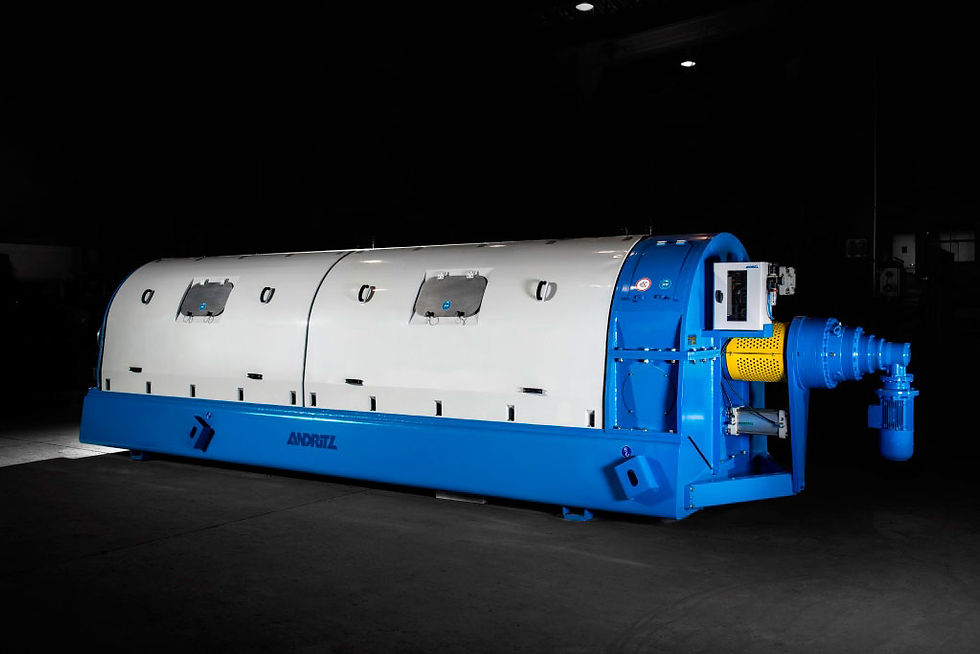
The C-Press features a specialized conical screw shaft with a variable pitch flight design spinning inside a cylindrical perforated basket. As the sludge moves axially along the basket, the space decreases, applying a steady, natural compression that forces filtrate out through the basket screen.
Performance Profile
Delivers high capacity dewatering with a dual-cleansing spray system that allows continuous cleaning without interrupting the filtration process loop.
Configurations
Available in multiple diameter sizes with single or parallel dual-screw configurations to scale precisely to your daily dry solids loading needs.
Best Suited For
Municipal sewage treatment plants (STPs), food and beverage processing units, pulp and paper facilities, and chemical effluent treatment plants (ETPs).
Key Advantage
Exceptional operational lifespan with ultra-low power consumption (often less than 2 to 4 kW), offering Indian industrial plants an incredibly low lifecycle cost (OPEX).

Technical Architecture: The Slow-Speed Compression Principle
The high performance of the ANDRITZ screw press relies on unique engineering details that distinguish it from standard multi-disc or conventional press variants:
Conical Shaft & Variable Pitch
The core screw shaft diameter increases gradually towards the discharge end, while the distance between the screw flights decreases. This forces the sludge into an increasingly tighter space, providing a smooth, gradual pressure ramp that prevents cake washouts.
Ultra-Low Rotational Speed
The screw turns at an incredibly slow rate (typically 0.5 to 2.5 RPM). This slow-speed action minimizes friction, reducing mechanical wear on the flight tips and screen baskets to absolute minimum thresholds.
Enclosed Visual Inspection Hatches
The entire basket assembly is shielded by gas-tight stainless steel hoods. Clear inspection windows allow operators to visually check the filtration wash cycles safely without exposure to hazardous aerosols or odors.
The Step-by-Step Screw Press Dewatering Process
1. In-Line Slurry Feed
Conditioned, polymer-flocculated sludge enters the base of the screw press via a specialized distribution inlet.
2. Gravity Drainage Zone
In the initial third of the basket, free water drains out rapidly by gravity through the screen perforations.
3. Compression Zone
As the sludge enters the reducing spaces of the variable flights, mechanical pressure rises steadily, pressing out tightly bound capillary water.
4. Adjustable Discharge Cone
A pneumatically regulated counter-pressure cone sits at the cake outlet. By adjusting the pneumatic pressure on this cone, operators can fine-tune the retention time inside the press to secure maximum cake dryness.
Meeting Environmental Compliance & ESG Directives in India
With Indian regulatory bodies imposing stricter environmental targets, the mechanical layout of your dewatering loop impacts both ESG metrics and utility overheads:
Power Optimization
Compared to high-speed decanter centrifuges, the slow-running ANDRITZ C-Press cuts electricity consumption by up to 80–90%, directly lowering a plant's scope 2 carbon footprint.
Odour and Safety Isolation
The completely enclosed housing contains volatile organic compounds (VOCs) and hydrogen sulfide ($H_2S$) gases, making it the preferred setup for installation inside sensitive zones like food manufacturing plants or near urban residential STPs.
Reduced Wash-Water Intake
The automated washing system uses internal spray bars that run intermittently rather than continuously, reducing clean water consumption by up to 70% compared to legacy belt systems.
Why Choose Amalgam Biotech as Your ANDRITZ Partner?
As an authorised ANDRITZ Screw Press partner, Amalgam Biotech provides access to world-class sludge dewatering technology backed by local technical expertise and support across India.
Verified Technical Expertise
As an authorised partner, we provide genuine equipment, original components, factory-approved engineering specifications, and access to official technical resources.
Application-Specific Sizing Guidance
We do not rely on standard sizing charts. Our team evaluates your plant's chemical and biological characteristics to recommend the most suitable equipment size.
End-to-End Commissioning Support
We work closely with your operations team, providing installation guidance, operational optimisation, and start-up support.
Complete Lifecycle Reliability
From initial laboratory testing to routine wear-part inspections, we provide ongoing support to help maximise uptime and maintain reliable system performance.
Looking for Andritz Screw Press System in India?
Struggling with rising sludge disposal costs, limited dewatering efficiency, or increasing environmental compliance requirements? ANDRITZ Screw Press Systems provide continuous, energy-efficient sludge dewatering with low maintenance requirements and reliable long-term performance.
Whether you operate a municipal STP, industrial ETP, pharmaceutical facility, chemical plant, food processing unit, textile mill, or pulp and paper operation, our experts can help you select the right screw press solution for your sludge management requirements.
Frequently Asked Questions
Q1: How does the ANDRITZ C-Press Screw Press achieve continuous sludge dewatering?
The ANDRITZ C-Press Screw Press uses a conical screw shaft with a decreasing flight pitch inside a cylindrical screen basket. As flocculated sludge moves through the press, the available space becomes smaller, gradually increasing compression to remove water. A pneumatic counter-pressure cone helps achieve higher cake dryness.
-
Process Breakdown:
-
Gravity Drainage Zone: Conditioned sludge enters the inlet, where free water quickly drains through the first section of the screen basket.
-
Compression Zone: The narrowing space between the screw flights gradually compresses the sludge, removing trapped capillary water.
-
Adjustable Outlet Cone: A pneumatically controlled discharge cone maintains the correct back pressure to maximise cake solids before discharge.
-
Q2: Why does the ANDRITZ C-Press consume up to 80–90% less energy than decanter centrifuges?
The ANDRITZ C-Press operates at very low rotational speeds, typically between 0.5 and 2.5 RPM, using direct-drive planetary gearboxes with small motors, usually 0.75 to 4 kW. This slow-speed mechanical dewatering removes the high energy demand associated with high-speed decanter centrifuges.
-
Key OPEX Benefits:
-
Low Energy Footprint: Helps reduce Scope 2 carbon emissions and monthly electricity costs.
-
Extended Component Life: Low rotational speed reduces wear on the screen basket liners and screw flights, increasing maintenance intervals.
-
Q3: How does the dual-cleansing spray system keep the Screw Press running without stopping sludge feed?
The ANDRITZ C-Press uses a bi-sequential dual-cleansing spray system that cleans the thickening and compression zones separately through internal spray rings. This automatic cleaning process keeps the screen basket clean without stopping continuous sludge feeding or diluting the dewatered cake.
-
Water Efficiency: Reduces wash-water consumption by up to 50 to 70% compared with conventional continuous belt washing systems, helping lower water use in STPs and ETPs.
Q4: What features of the ANDRITZ C-Press support indoor and urban environmental compliance?
The ANDRITZ C-Press has a fully enclosed, gas-tight stainless steel hood with inspection windows that helps contain H₂S and VOCs. Operating at noise levels below 60 dB(A), it is well suited for STPs near residential areas and sensitive food manufacturing facilities.
-
Operator Safety: The gas-tight enclosure helps prevent odours and airborne aerosols from escaping, creating a safer and cleaner working environment.
Q5: What industries in India benefit most from ANDRITZ C-Press Screw Press technology?
ANDRITZ C-Press Screw Presses are widely used in municipal Sewage Treatment Plants (STPs), food and beverage facilities, pulp and paper mills, chemical Effluent Treatment Plants (ETPs), and pharmaceutical plants that require continuous, low-noise sludge dewatering with minimal operator involvement.
-
Sizing Flexibility: Available from small pilot units handling 20 kg DS/hr to high-capacity dual-screw systems processing up to 1,300 kg DS/hr, making them suitable for a wide range of industrial applications across India.
Q6: What maintenance and monitoring automation is available for ANDRITZ Screw Presses?
ANDRITZ Screw Presses can be integrated with Metris addIQ control systems for real-time monitoring of screw speed, counter-pressure, and automated wash cycles. Split-basket designs and accessible inspection hatches allow quick replacement of wear liners without removing the main shaft or screen basket.
-
Local Technical Partner: Through Amalgam Biotech, customers across India receive sludge characterisation, custom system sizing, installation, commissioning, and complete after-sales technical lifecycle support.